Our team delivers core analysis (CCA/SCAL), PVT and flow assurance, formation damage, geomechanics, and geological services to the independent oil companies. Furthermore, with considering internal capabilities, our team can perform some of the experiments that cannot be in the country through our international and reputable companies.
Geological Studies
In the Geology Department, comprehensive analyses are conducted to better understand the characteristics and behavior of subsurface rocks. These studies are essential for reservoir evaluation, exploration, and resource management. The lab employs three distinct scales of analysis: core, plug and thin section scale to gather detailed insights into rock properties, facies, porosity, and diagenesis.
- Core Scale Analysis
Whole core analysis, including facies analysis, lithology, fracture studies, diagenesis, and sequence stratigraphy.
- Plug Scale Analysis
Archie’s classification, porosity types, and fracture studies.
- Thin Section Scale Analysis
Detailed lithology and facies studies, types of porosity, diagenesis (both reservoir quality-enhancing and reservoir quality-reducing), sequence stratigraphy, and rock typing.
- UV and White Light Photography of Core, Plug, and Thin Section Samples
- SEM & Isotope analysis
- XRD/XRF analysis


RCAL
The basic characteristics of core such as porosity, permeability and saturation come from routine core analysis.? Also, depth matching of wellbore logging can be done by using core gamma logging. The RCAL Services are listed as below:


SCAL
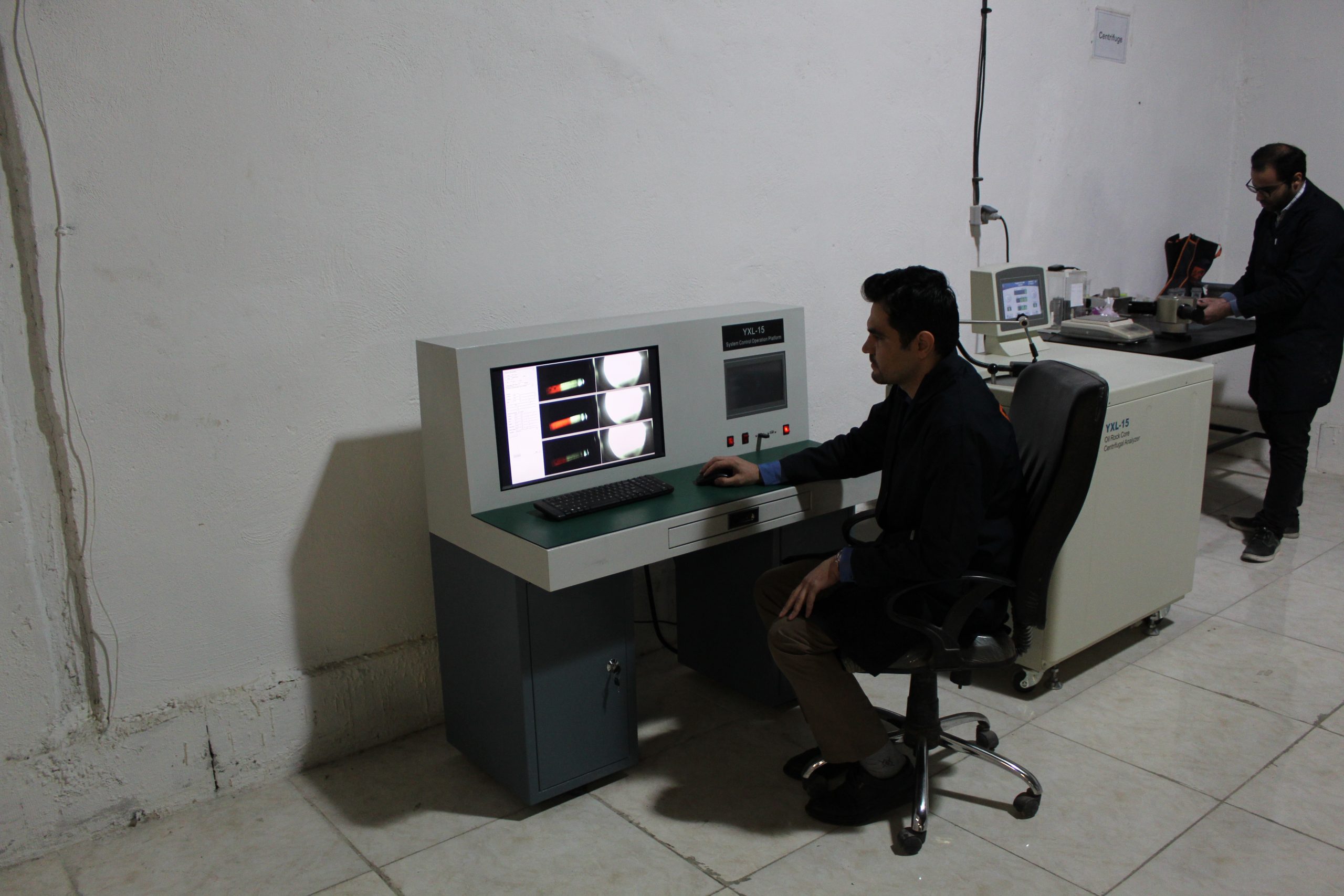
Detailed understanding of reservoir characteristics such as relative permeability, capillary pressure, electrical parameters (Archie exponents), and wettability requires additional measurements obtained in the special core analysis laboratory. The SCAL services are listed as below:


Fluid Analysis
PVT data provide the necessary information to properly determine fluid in place, recovery estimate and material balance calculations. In collaboration with our partners, we provide fluid sampling, flow assurance, crude assay, and PVT analysis services.
Asphaltene Studies
One of the important challenges of Iranian oil upstream industries in near future will be flow assurance problems in which contain all organic & inorganic deposits. All the routine experiments related to asphaltene studies are being conducted in Asmary laboratory. Besides, different operational treatment methods including: